
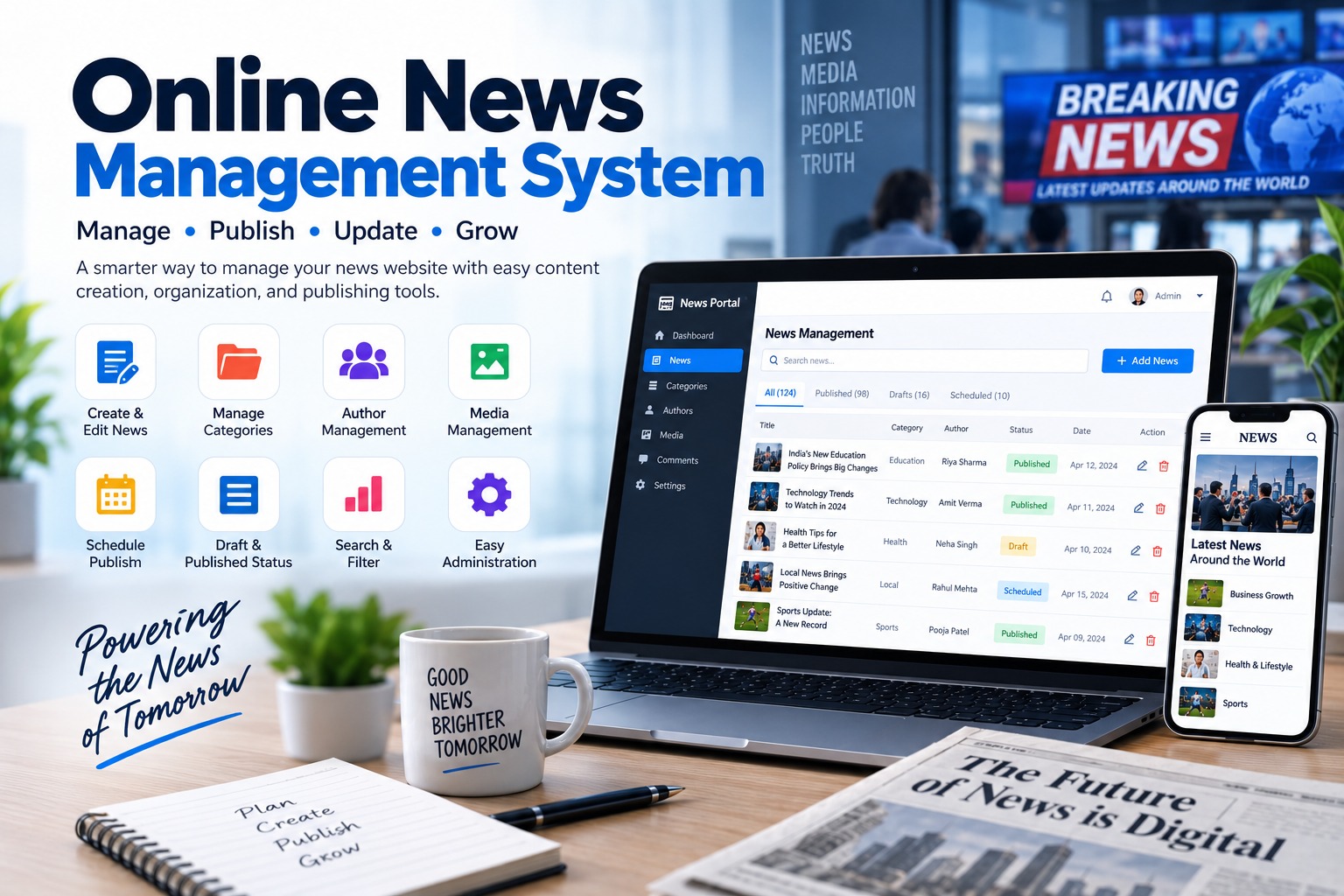

Online News Management System: A Complete Guide for Modern News Websites
The digital news industry is growing rapidly. Readers now expect news websites to provide fresh information, easy navigation, fast updates, and a smooth experience across smartphones, tablets, and computers.
For publishers, meeting these expectations requires more than good content. They also need an efficient system to create, organize, manage, update, and publish news.
This is where an Online News Management System becomes useful.
A dedicated news management platform allows publishers, editors, reporters, and administrators to manage website content from a centralized dashboard. Instead of handling articles and website updates manually, teams can use one organized system to control their publishing activities.
A modern system can help manage articles, categories, authors, images, publishing status, updates, and other essential content operations.
Whether you are managing a local news website, digital newspaper, media organization, community portal, or online publication, the right system can make everyday news management more efficient.
In this guide, we will explore what an Online News Management System is, how it works, its important features, its benefits, and how to choose the right solution for your news website.
What Is an Online News Management System?
An Online News Management System is a web-based software solution designed to help organizations manage news and digital content through a centralized platform.
It provides administrators and content teams with tools to create, edit, organize, publish, and update news articles.
Instead of managing every article as a separate website page, publishers can use a structured content management environment.
For example, an administrator may be able to:
- Add a new news article
- Edit existing news
- Select a category
- Add an author
- Upload a featured image
- Manage article status
- Publish content
- Update published articles
- Search older content
- Organize large amounts of news
This centralized approach makes news website administration easier.
It also allows content teams to follow a consistent publishing process.
Why Do News Websites Need a Management System?
Managing a small number of articles manually may seem simple. However, the process becomes more complicated when a website starts publishing content every day.
A growing news website may have:
- Multiple reporters
- Different categories
- Hundreds of articles
- Thousands of images
- Regular content updates
- Multiple administrators
- Frequent breaking news
- Archived articles
Without a structured system, finding and updating content can become time-consuming.
For example, imagine an editor needs to update an article published three months ago. If the website has hundreds of pages and there is no proper search or content management system, locating that article can take unnecessary time.
An Online News Management System solves this problem by organizing content inside a centralized dashboard.
As a result, publishers can manage their website more efficiently and maintain a better publishing workflow.
How Does an Online News Management System Work?
The basic process is simple.
A reporter or content creator prepares an article through the management dashboard. The article can then be edited, categorized, and prepared for publication.
Once the content is ready, an administrator or editor can publish it on the website.
A typical workflow may look like this:
Create → Edit → Categorize → Add Media → Review → Publish → Update
This workflow helps teams maintain better control over their content.
If an article needs new information later, an editor can open the existing article, make the required changes, and publish the updated version.
Therefore, the system supports the complete content lifecycle rather than only the initial publication.
Key Features of an Online News Management System
A professional news management platform should provide practical features that make everyday publishing easier.
Here are some of the most important features.
1. News Article Management
Article management is the core function of any news management platform.
Administrators and editors should be able to create new articles and manage existing content from one dashboard.
Important fields can include:
- News title
- Article description
- Main content
- Featured image
- Category
- Author
- Publication status
- Date
A structured article management system makes it easier to maintain a large content library.
2. Category Management
A news website can cover many different topics.
For example:
- National News
- Local News
- Business
- Education
- Technology
- Health
- Sports
- Entertainment
- Agriculture
- Politics
Category management allows administrators to organize articles according to their subject.
This makes the website easier to navigate for readers.
It also helps content teams maintain a consistent structure as the website grows.
3. Author Management
News websites often have several reporters, writers, and editors.
An author management feature allows administrators to associate articles with the correct writer.
This helps maintain better content organization.
For larger publications, author management can also make it easier to understand who is responsible for different pieces of content.
4. Featured Image Management
Images are an important part of modern digital publishing.
A relevant featured image can make an article more visually attractive on:
- Homepage
- Category pages
- Search pages
- News listings
- Social media previews
An Online News Management System should make uploading and managing these images simple.
A centralized media management process also helps publishers maintain consistent visual content.
5. Draft and Published Status
Not every article is ready for immediate publication.
An editor may need to review the content before it goes live.
Therefore, a good system should support different content statuses.
Common statuses include:
Draft
Content is still being prepared.
Published
Content is live on the website.
Scheduled
Content is prepared for future publication.
Archived
Older content is retained for reference.
These statuses provide better control over the publishing process.
6. News Search and Filtering
As the number of articles increases, search becomes essential.
Administrators should be able to quickly locate articles using different filters.
For example, they may search by:
- Title
- Category
- Author
- Date
- Status
- Keyword
This feature can save significant administrative time.
Instead of manually checking multiple pages, users can find the required content through the dashboard.
7. Content Editing and Updating
News is constantly changing.
An article may require an update when new information becomes available.
For example, an initial report may only contain basic information. Later, the publisher may need to add new details, images, or statements.
An effective News Content Management System allows editors to update existing articles without creating a completely new page.
This helps keep information organized and reduces unnecessary duplicate content.
8. User and Admin Management
A professional news platform may have different users with different responsibilities.
For example:
- Super Administrator
- Administrator
- Editor
- Reporter
- Content Writer
Depending on the system, each user can be given appropriate access.
This provides better administrative control and helps create a structured publishing environment.
9. Responsive News Website
Readers use different devices to access online news.
Therefore, the website connected to the management system should provide a responsive experience.
News content should be easy to read on:
- Smartphones
- Tablets
- Laptops
- Desktop computers
A mobile-friendly design is especially important because many users consume digital news through mobile devices.
10. Centralized Dashboard
A centralized dashboard brings important management functions into one place.
Instead of switching between multiple tools, administrators can manage their content from one interface.
A dashboard may include:
- Total news articles
- Published articles
- Draft articles
- Categories
- Authors
- Recent updates
- Content management options
This provides administrators with a clearer view of website activity.
Benefits of an Online News Management System
Implementing a dedicated management system can provide several practical advantages.
. Better Content Organization
One of the biggest benefits is improved organization.
Articles can be grouped by category, author, date, and status.
This makes it easier for administrators to manage both new and old content.
2. Faster Publishing
Speed is important in online journalism.
When a major event happens, publishers may need to share verified information quickly.
A centralized publishing system reduces unnecessary steps.
As a result, editors can prepare and publish content more efficiently.
3. Easier Content Updates
News stories can change throughout the day.
With a dedicated system, editors can quickly find an article and update the information.
This keeps the website current and organized.
4. Reduced Manual Work
Manual content management can involve repetitive tasks.
A structured system reduces unnecessary administrative work by providing dedicated tools for common activities.
Therefore, content teams can spend more time on research, writing, editing, and publishing.
5. Better Team Collaboration
A news website may involve several people.
Reporters create content. Editors review it. Administrators manage the website.
A centralized system provides a common environment where these activities can be coordinated more effectively.
6. Easier Management of Large Content Libraries
As a website grows, managing thousands of articles manually becomes difficult.
An Online News Management System provides tools such as search, filtering, categories, and status management.
These features make large content libraries easier to maintain.
7. Improved Reader Experience
Although the management system primarily helps administrators, readers also benefit from better content organization.
Well-managed categories and regularly updated content can make the website easier to navigate.
Readers can find relevant stories more quickly.
Online News Management System for Local News Websites
Local news publishers have unique content requirements.
They may cover:
- Cities
- Villages
- Districts
- Local events
- Government announcements
- Education
- Community activities
- Local businesses
- Regional issues
A structured management system allows publishers to organize this information effectively.
For example, a publisher can create categories based on location and topic.
This makes it easier for readers to discover news that is relevant to their area.
Online News Management System for Media Organizations
Media organizations often manage content from multiple contributors.
A centralized platform can help them maintain a consistent workflow.
Editors can review articles, administrators can manage users, and reporters can submit content through the same system.
This structure can be especially useful when the organization publishes content frequently.
Instead of relying on disconnected tools, the organization can create a more unified publishing process.
How It Supports Digital News Publishing
Digital publishing requires more flexibility than traditional print publishing.
Online content can be updated at any time.
Stories can be published immediately. Images can be replaced. Headlines can be updated. New information can be added.
An Online News Publishing System provides the infrastructure needed to handle these activities.
It allows publishers to treat their website as a continuously updated information platform rather than a collection of static pages.
Important Factors When Choosing an Online News Management System
Choosing the right system requires careful consideration.
Every publisher has different requirements. Therefore, the best solution should match the organization’s workflow and future plans.
Ease of Use
The dashboard should be simple and easy to understand.
Editors and writers should be able to manage content without extensive technical knowledge.
Scalability
The platform should support growth.
As the number of articles, users, categories, and visitors increases, the system should continue to support the website efficiently.
Customization
Different organizations have different publishing requirements.
A customizable News Website Management Software solution can be adapted to specific business or editorial needs.
Security
Administrative systems should follow appropriate security practices.
User accounts, content, and website data should be protected against unauthorized access.
Mobile Compatibility
The final website should work smoothly across different devices.
A mobile-friendly experience is essential for modern digital publishers.
Performance
A news website may receive significant traffic during major events.
Therefore, performance and efficient content delivery should be considered when selecting the technology.
Technical Support
Reliable support can be valuable when the website is an important part of an organization’s operations.
Consider maintenance, updates, troubleshooting, and technical assistance when evaluating a software provider.
Custom Online News Management System vs. Ready-Made Software
Publishers generally have two approaches.
They can use a ready-made platform or develop a customized solution.
A ready-made solution may be suitable when the organization’s requirements are standard.
However, custom development can provide greater flexibility when a publisher needs specific workflows or features.
For example, a custom platform can be designed around:
- Specific user roles
- Custom categories
- Unique publishing workflows
- Special dashboards
- Custom reporting
- Organization-specific requirements
The right choice depends on budget, technical requirements, publishing volume, and long-term objectives.
How a News Management System Can Support Business Growth
A growing news website needs a system that can grow with it.
Initially, a publisher may have only a few articles and one administrator.
Later, the website may have multiple reporters, editors, categories, and thousands of articles.
Without proper infrastructure, this growth can create management challenges.
A scalable Digital News Management Platform can help organizations handle increasing content requirements in a more structured way.
It provides a foundation for managing content as the publication expands.
Best Practices for Managing News Content Online
Technology is only one part of successful digital publishing.
Publishers should also follow good content management practices.
Keep Categories Organized
Avoid creating too many unnecessary categories.
Use a clear structure that helps readers find information easily.
Use Clear Headlines
Headlines should communicate the main topic of the article clearly.
Avoid unnecessary complexity.
Optimize Images
Use appropriate image sizes and formats to maintain a good website experience.
Keep Content Updated
When important information changes, update relevant articles promptly.
Maintain Consistency
Use consistent formatting for headlines, descriptions, images, authors, and categories.
Review Content Before Publishing
A review process can help identify errors before an article goes live.
The Future of Online News Management
The digital publishing industry will continue to evolve.
News websites are becoming more data-driven, mobile-focused, and personalized.
Publishers are also looking for ways to improve content workflows and manage growing volumes of information.
Future news management platforms may increasingly focus on:
- Smarter content workflows
- Advanced analytics
- Automation
- Personalized content
- Multi-platform publishing
- Improved media management
- Better audience engagement
However, the fundamental requirement will remain the same.
Publishers need a reliable system that allows them to manage content efficiently.
That is why an Online News Management System can become an important part of the technology infrastructure of a modern news website.
Why Businesses Should Invest in a Professional News Management System
A news website is often updated continuously.
If administrators have to depend on developers for every content update, the publishing process can become slower and less flexible.
A professional management system gives content teams greater control.
They can create, edit, organize, and publish content through the dashboard.
This improves operational efficiency and allows organizations to respond faster to new information.
In addition, a structured platform provides a better foundation for future improvements.
As the organization grows, new features and integrations can be added according to its requirements.
Build a Smarter Digital News Platform
Managing digital news should not be unnecessarily complicated.
A well-designed Online News Management System brings important publishing activities into one organized platform.
From article creation and category management to author administration, media handling, search, filtering, and content updates, the system can simplify the daily responsibilities of publishers and editors.
For local news websites, media organizations, digital publications, community portals, and institutions, a dedicated management solution can provide the flexibility needed to manage content efficiently.
The goal is simple: make news management faster, more organized, and easier to scale.
With the right technology, publishers can focus more on delivering valuable information while the platform takes care of the underlying content management workflow.
Conclusion
The modern news industry depends on speed, accuracy, organization, and accessibility.
As digital publications grow, managing news content manually becomes increasingly challenging. An Online News Management System provides a centralized solution for managing articles, categories, authors, images, publishing statuses, and content updates.
It can help reduce repetitive work, improve publishing workflows, organize large content libraries, and provide administrators with better control over their websites.
Whether you are running a local news portal, digital publication, media organization, or community website, choosing the right management platform can make a significant difference.
A professional system should be easy to use, scalable, secure, customizable, and capable of supporting your publishing requirements as your website grows.
Ultimately, the right Online News Management System is not just a tool for publishing articles. It is a foundation for building a more organized, efficient, and scalable digital news platform.